




By Jenny Bennett
In a speech broadcast on Iranian public television (IRIB) on the 29th of March 2026, Iranian forces Lieutenant-Colonel Ebrahim Zolfaqari warned, “… (enemy) commanders and soldiers will be food for the sharks of the Persian Gulf”1. I fear for the future of those sharks there; if there will actually be any sharks left in the Persian Gulf, given what is currently happening in the Hormuz Strait and what has been happening in the wider Gulf for over 100 years (commercial over-fishing, industrial pollution, land reclamation, and increased salinity levels due to these anthropogenic activities and the warming climate).
In the NNW of the Indian Ocean, the Arabian Sea feeds into the Gulf of Oman, which leads into the Strait of Hormuz and then the Persian Gulf. The region has ̃30 known endemic species of shark and some of the most threatened chondrichthyan (sharks and their cousins, rays and skates) populations in the world2. The narrow shipping lane that runs through the Strait of Hormuz Corridor, transporting roughly 20% of global oil and gas and a third of the world’s fertilisers, is always very busy and sharks must swim this gauntlet to access the critical habitats of the shallower waters along the coasts of Iran, Iraq, Kuwait, Saudi Arabia, Bahrain, Qatar and the UAE. The usual high level of maritime traffic negatively impacts the sharks, and now many burning, burnt-out and sunken vessels and the subsequent oil spills are further polluting the already heavily polluted waters of this semi-enclosed sea, where there is limited flow – meaning pollutants cannot flush out quickly nor easily – and only one way for the sharks to get back out to the relative safety of the open ocean. Traffic build up during the five week closure saw up to 3200 vessels stuck in the Strait, with 20,000 seafarers on board.
War taking place in/on the water is lethal for marine species: there is greater pollution in terms of spilled oil and debris (missiles, drones and destroyed or partly-destroyed vessels), and the noise associated with explosions (underwater mines and ships being blown up) will not only have an impact on prey fish (killing them, maiming them or forcing them out of the area; leaving predators with fewer opportunities to feed); but will also effect sharks. We know from acoustic deterrents that noises impact shark behaviour, so what are massive underwater and on water explosions doing to shark behaviour and biology? Apart from the obvious – blast injuries – the shock waves from explosions cause internal bleeding as sharks’ organs rupture; water is almost incompressible, so it transmits shock waves very effectively, causing intense pressure on sharks’ very sensitive auditory systems, which are destroyed by the blast sound field; intense noise and the subsequent pressure changes in the water can cause significant disturbances to behaviour, all affecting sharks’ ability to navigate and locate food3. The critical importance of sharks for a heathy marine ecosystem is well documented, so sea-based war indisputably causing marine ecocide impacts the entire planet. The International Union for Conservation of Nature’s (IUCN) Shark Specialist Group had officially designated a number of Important Shark and Ray Areas (ISRAs) in the Persian Gulf4. This means areas have been identified as critical habitats for the survival of the shark species concerned: because they are essential feeding grounds, shark reproductive areas and nurseries and migratory corridors. Threatened species, range-restricted species and undefined aggregations of sharks use the Persian Gulf, which is now in the middle of a war zone.
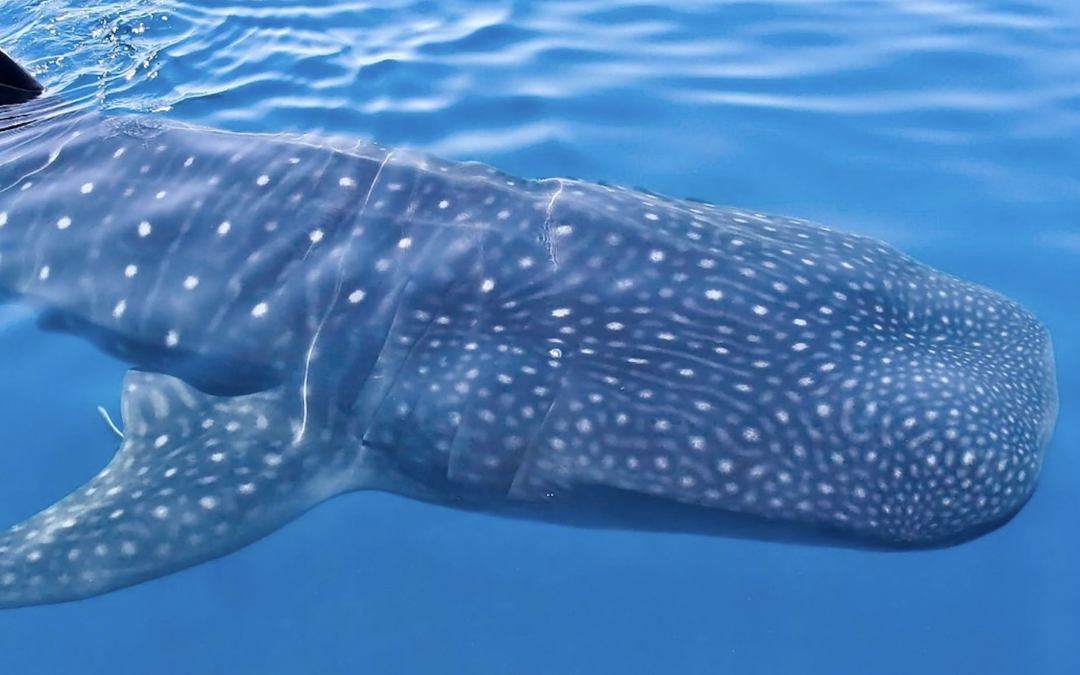
The Strait of Hormuz Corridor itself is a critical migratory path used by Whale Sharks, for example, moving from the Persian Gulf to the Gulf of Oman. They are officially an endangered species; their populations having decreased by over 50% since the 1950s5, due to being killed as commercial fishing bycatch, by habitat destruction, because of climate-induced habitat changes and by ship strike. This area also supports critical habitats for other threatened species, such as the critically endangered Tentacled Butterfly Ray (Gymnura tentaculata).
This is the sixth week of the illegal US-Israeli war against Iran. As of 8th April, a fragile two-week ceasefire is in place. Trump wants to control or destroy Kharg/Khark Island because it is where Iran’s oil export terminal is located; the US have twice struck this island already – a five by three mile coral outcrop roughly twenty miles off of Iran’s coast in the Persian Gulf. Aside the critical economic importance for Iran, Kharg Island has great historical importance: there is an 18th-century fortified trading station built by the Dutch East India Company; there are the ruins of one of the oldest Christian monasteries in the region and there are rock carvings that are 2400 years old6. But what about the environmental importance? Its location puts it in between three identified ISRAs that are a vital habitats for the officially vulnerable Bull Shark (Carcharhinus leucas), the endangered Cownose Ray (Rhinoptera jayakari), the endangered Whitecheek Shark (Carcharhinus dussumieri), and the endangered Whale Shark (Rhincodon typus). The largest fish in the world – the Whale Shark – gather in the Persian Gulf to feed on tuna eggs between April and September – i.e. NOW, in the middle of this war. Fishers have reported aggregations of between 30 and 100 Whale Sharks swimming close to oil and gas platforms in the area, and researchers recorded approximately 600 individuals in 2023 (6); this is a globally significant site for these ocean giants. There are many further species here where data is deficient and so they have not been officially evaluated and their statuses remain unknown; they need protection until their statuses can be established.
Kish Island, just off the south of the mainland, opposite the UAE, is another Iranian island that is a recognised ISRA, crucial to sharks – in this case, especially to juvenile Blacktip Reef Sharks (Carcharhinus melanopterus), who aggregate there in March and April (NOW) and whose status is vulnerable on the Red List. The UAEs Sir Bu Nair Island has protected status in name and is used by Blacktip Reef Sharks, present the year-round, as a reproductive area.
Despite their obvious and significant importance, most of these ISRAs are not protected by “no-take” zones. Why is it that in an area where many of the regional species are considered among the most threatened globally, due to the unsustainable practices of commercial and illegal fisheries, and now the additional threat from war, there is no meaningful protection?
Roughly 90 km offshore from Doha, there are undefined aggregations of Scalloped Hammerhead Sharks (Sphyrna lewini); which are listed as critically endangered. At the Convention on Migratory Species (CMS) at CoP15, 29 March 2026, new protections were granted by adding them to the CMS Appendix 1, which obligates governments to implement strict measures to reduce human-caused mortality7. Does this have any standing during this war?
More than one-third of sharks and their relatives are threatened with extinction as of 20258. Populations of sharks in the open ocean declined by 71% between 1970 and 20209. Localising to the Persian Gulf, there has been limited political will to address the shark data deficit and what will there is, is disabled by national and regional incapacities to assess, manage, conserve or rebuild stocks10.
Observing sharks for sale at supermarket fish counters in Bahrain prompted concern that led me to attempt to address the great data deficit pertaining to sharks in Bahraini waters specifically. I collected new data to justify the necessity of shark protection; the data was collected from observations at fish markets, supermarket fish counters, landing docks and via interviews with fishers. At the time of data collection, no one else had undertaken shark-focused landing surveys in Bahrain since 2012. Individual specimens of multiple species that are listed as Near Threatened, Vulnerable, Endangered and Critically Endangered on the IUCN Red List were recorded as being fished during my research. These individuals were mostly female juveniles in number, followed by male juveniles and then there were some pregnant females. This evidence proved the concerns that had initially prompted my project. I presented this critical data to the Bahraini Supreme Council for the Environment and produced a shark protection law for the Kingdom, which was submitted for legal review. Five years later, the shark protection law has now been absorbed into a new raft of environment protection laws for the Kingdom of Bahrain, due to be ratified at some point this year. In this way, I was able to achieve vital legal protection for vulnerable shark species in the territorial waters of the Kingdom of Bahrain. But of course, now with this war in the Middle East, in which Bahrain is being hit, the ratification of my shark protection law will not be a priority. I am worried that many sharks will be killed by this war before the ratification and subsequent enforcement policies can take effect.
We could protect marine animals during war within the application of environment protection under anti-ecocide laws that are newly being created in an emerging, global ecocide-focused movement that is trying to tackle mass harm to nature: in December 2022, the UN General Assembly approved the International Law Commission’s draft principles on the protection of the environment in armed conflict; in July 2025, the ICJ published advisory opinion on states’ obligations to protect the climate system; in October 2025 the IUCN recognised ecocide as a crime. Now legal debate must lead to implementation. Marine life is not being considered during this conflict. Creating protected marine safe zones could be an option, but would no doubt be used as advantageous by bad actors. War/profit trumps planet. We see this no more clearly than when the American Endangered Species Committee exempted oil and gas activities in the Gulf of Mexico on the 31 of March 2026, overriding the Endangered Species Act (ESA), removing protections and putting threatened and endangered marine species at great risk. It is a precedent that must not be followed. There must be peacetime anti-ecocide laws that are not meaningless in wartime. Ecocide should become an international crime, like genocide. In September 2024, three Pacific Island states proposed to add ecocide to the list of crimes tried at the International Criminal Court in the Hague and now diplomatic backing is being sought11. If ecocide is added to the ICC’s statute, it would be the fifth international crime, following those of: genocide, war crimes, crimes against humanity and the crime of aggression. Accountability must be pursued through regional mechanisms, national legislation and the global courts. It is upon these frameworks that we can build protections for sharks in war zones.
About the author:
Jenny Elliott-Bennett is an environment and animal rights campaigner, boots on the ground / front line activist, operating in the UK, Europe and the Middle East; making positive impact for the protection of animals and the environment that ranges from war zone rescue and extraction to writing new policy and law.
- IRIB broadcast, re-broadcast on YouTube, 30 March 2026. Accessed online, 1 April 2026: https://www.youtube.com/watch?v=3pUS2QWqUbI ↩︎
- Jabado et al, 2018. Troubled waters: Threats and extinction risk of the sharks, rays and chimaeras of the Arabian Sea and adjacent waters. Wiley Online Library, accessed online, March 2026: https://onlinelibrary.wiley.com/doi/full/10.1111/faf.12311 ↩︎
- Dylewska et al, 2026. Raise the Shields: Protecting Marine Animals from Underwater Explosions, Illustrated by Noise Abatement Modeling. In: Popper, A.N., Sisneros, J., Lepper, P., Vigness-Raposa, K. (eds) The Effects of Noise on Aquatic Life IV. Accessed online, 1 April 2026: https://doi.org/10.1007/978-3-031-94229-7_50-1 ↩︎
- IUCN SSC. Persian Gulf ISRAs, accessed online, 1 March 2026: https://sharkrayareas.org/portfolio-item/al-shaheen-isra/ ↩︎
- McCoy, Mary Kate. November 2024. Climate change charts a dangerous course for the world’s largest fish. Conservation International, accessed online, 1 April 2026:
https://www.conservation.org/news/climate-change-charts-a-dangerous-course-for-the-worlds-largest-fish ↩︎ - Zeteo. April 2026. Kharg Island: Everything You Need to Know About the Island Trump Wants to Invade. Accessed online, 1 April: https://open.substack.com/pub/zeteo/p/trump-iran-kharg-island?utm_campaign=post&utm_medium=email ↩︎
- Dive Magazine, March 2026. New shark protections agreed at CMS CoP15 in Brazil. Accessed online, March 2026: https://divemagazine.com/scuba-diving-news/new-shark-protections-agreed-at-cms-cop15-in-brazil ↩︎
- IUCN, 2024. Press release, accessed online, March 2026: https://iucn.org/press-release/202412/third-sharks-rays-and-chimaeras-are-threatened-extinction-new-report-narrows ↩︎
- Pacoureau et al, 2021. Half a century of global decline in oceanic sharks and rays. Nature 589: 567–571. https://doi.org/10.1038/s41586-020-03173-9 ↩︎
- Jabado et al, 2018. Troubled waters: Threats and extinction risk of the sharks, rays and chimaeras of the Arabian Sea and adjacent waters. Wiley Online Library, accessed online, March 2026: https://onlinelibrary.wiley.com/doi/full/10.1111/faf.12311 ↩︎
- Pannett, Rachel. September 2024. What is ecocide and could it become an international crime like genocide? Accessed online, 1 April: washingtonpost.com/climate-environment/2024/09/10/ecocide-law-crime-genocide-icc/ ↩︎