


by Niamh McConnell
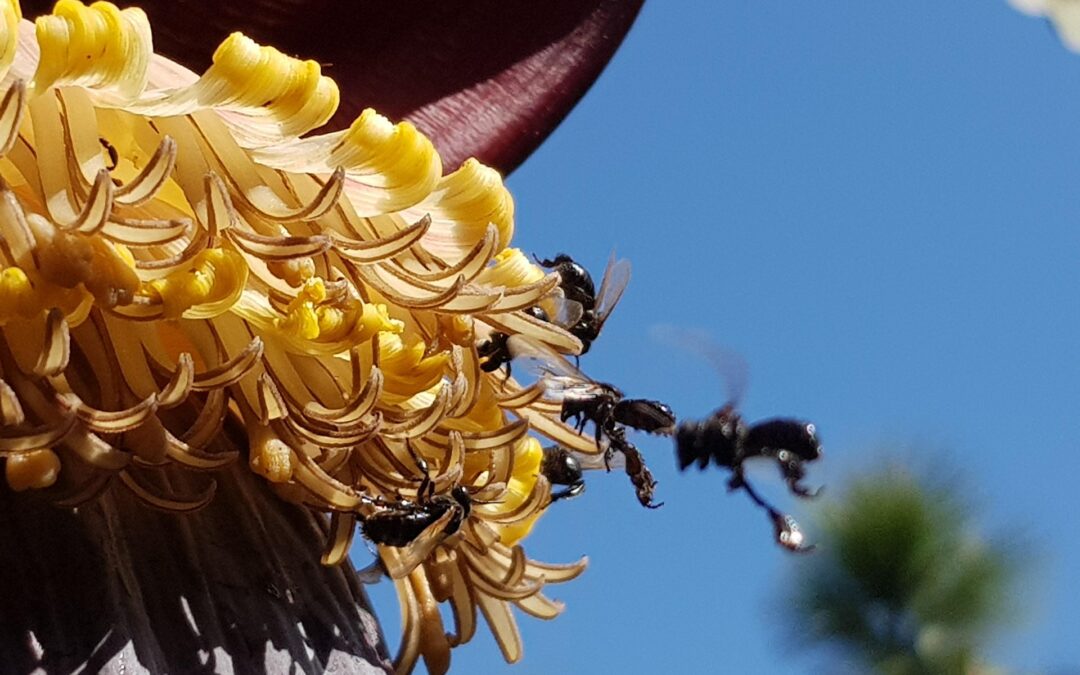
Bees play a vital role in pollination, sustaining the world’s food supply. It has been said that if bees were to disappear off the surface of the globe, humanity would only have four years of life left.1 They are particularly crucial in the ecosystem of the vast Amazon rainforest where they are responsible for pollinating more than 80% of the flora, as well as valuable commodities such as crops like cacao, coffee, fruit trees, and avocados. However, their habitat and existence are under threat due to a number of man-made issues, including deforestation, pesticides and climate change.
In recognition of their importance, the municipality of Satipo passed Ordinance No. 332025CM/MPS2 on the 21 October 2025, and the Provincial Municipality of Nauta-Loreto in Peru approved Municipal Ordinance N.º 172025MPLN3 on the 22 December 2025, bothrecognising the rights of over 175 native stingless bees in Peru.
Non-human animals have been granted legal rights in a range of different ways across the world, some implied others explicit, offering a range of protections, and some rights as part of their environment while others are specific to a species or individuals. However,these decisions on bees are understood to be the first time any government has introduced a specific law formally recognising the explicit legal rights of an insect.
Both ordinances build upon Peru’s national Law 32235 published on the 9 January 2025, which introduced protections for stingless bees at a national level. The new measures go further than protecting the bees as a species. Stingless bees are now recognised as legal subjects. Across the Avireri Vraem Biosphere Reserve and other protected areas of the Amazon, stingless bees have now been granted a number of fundamental rights including:
- the right to exist and thrive
- the right to maintain healthy populations
- the right to a healthy environment free from pollution
- the right to ecologically stable climatic conditions
- the right to regenerate their natural cycles
- the right to be legally represented in cases of threat or harm
In practical terms, this means that individuals, communities, or organisations may bring legal actions on behalf of the bees where activities such as deforestation, pesticide use, or pollution threaten their survival. Any company or individual that damages their colonies can now be subject to legal action in Peru.
The ordinances were supported by a joint technical report from Amazon Research Internacional and Earth Law Center, working alongside the Asháninka Communal Reserve and EcoAsháninka.4 Constanza Prieto, Latin American director at the Earth Law Center, described the reform as “a turning point in our relationship with nature” arguing it makes stingless bees visible as rights-bearing subjects rather than invisible economic contributors. Rosa Vásquez Espinoza fromAmazon Research Internacional similarly observed that the reform demonstrates how modern science and ancestral wisdom can come together to create real conservation solutions.5
However, the story is not over: a global petition led by Avaaz6 has accumulated more than 390,000 signatures at the time of writing, calling for national-level protection. More closely, it urges national lawmakers to adopt a “Rights of Nature Declaration for Stingless Bees”. This is hoped to achieve a ripple effect, inspiring other countries across the world to follow suit, establishing a powerful precedent.7 Environmental groups in Bolivia, the Netherlands, and the United States are studying Peru’s model as a potential template for protecting their own wild pollinators.8 With continued pressure on local and national levels, we can feel more confident that bees will not disappear off the surface of the globe, allowing us to continue benefiting from their valuable contributions.
Bibliography:
Avaaz, ‘Rights for Stingless Bees’ (14 October 2025)
Earth Law Center, ‘In a Precedent with No Equivalent Worldwide, the Provincial Municipality of Satipo Approves Legal Rights for Native Stingless Bees’ (Press Release, 24 November 2025)
Ghai R, ‘Amazonian Stingless Bees First Insects to Get Legal Rights in the World’ Down To Earth (31 December 2025)
Kaplow S, ‘The Right to Bee – Peru’s Recognition of Legal Rights for Stingless Bees’ (22 February 2026)
Maeterlinck M, The Life of the Bee (1901)
Municipalidad Provincial de Satipo, Ordenanza Municipal N° 033-2025-CM (27 October 2025)
Municipalidad Provincial de Satipo, Resolución Gerencial N° 00017-2025-GM-MPS (16 January 2025)
About the author:

Niamh is a first year student studying Law at the University of Exeter. After completing an EPQ on animal law, she has continued to develop her interest in this area by volunteering with a small dog rescue charity and supporting its campaign for greater regulation of dog rescues.
- Maurice Maeterlinck, The Life of the Bee (1901) ↩︎
- Municipalidad Provincial de Satipo Ordenanza Municipal N° 033-2025-CM (27 October 2025) ↩︎
- Municipalidad Provincial de Satipo, Resolución Gerencial N° 00017-2025-GM-MPS (16 January 2025) ↩︎
- Earth Law Center ‘In a Precedent with No Equivalent Worldwide, the Provincial Municipality of Satipo Approves Legal Rights for Native Stingless Bees’ (Press Release, 24 November 2025) ↩︎
- Earth Law Center ‘In a Precedent with No Equivalent Worldwide, the Provincial Municipality of Satipo Approves Legal Rights for Native Stingless Bees’ (Press Release, 24 November 2025) ↩︎
- Avaaz, ‘Rights for Stingless Bees’ (14 October 2025) ↩︎
- Rajat Ghai, ‘Amazonian Stingless Bees First Insects to Get Legal Rights in the World’ Down To Earth (31 December 2025) ↩︎
- Stuart Kaplow, ‘The Right to Bee – Peru’s Recognition of Legal Rights for Stingless Bees’ (22 February 2026) ↩︎